
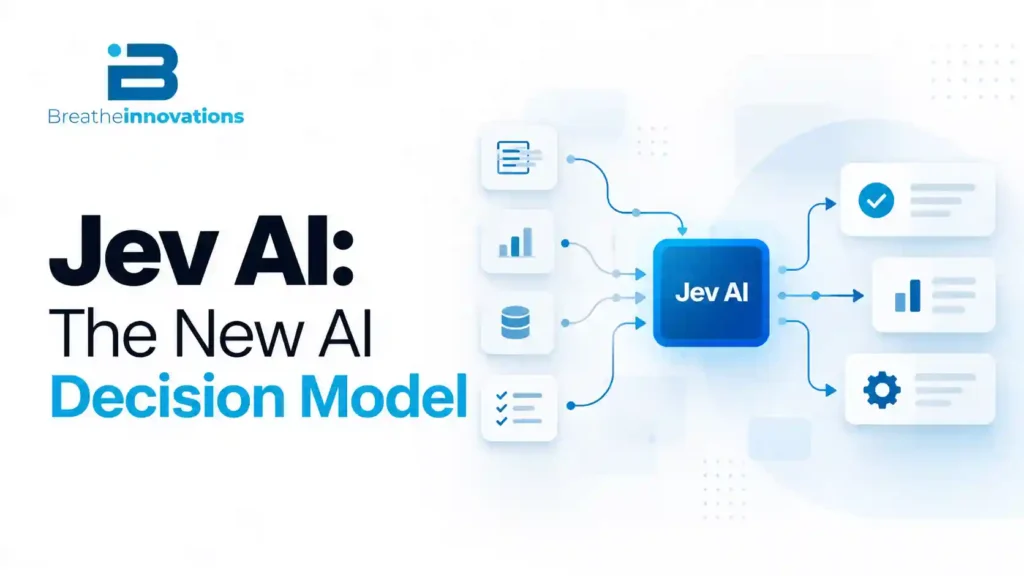
Jev AI is a new decision-focused AI model from TypeSafe AI, designed to help software make fast, structured decisions instead of generating long pieces of text.
What Is Jev AI?
Jev AI is TypeSafe AI’s first System One model. It takes supplied context and focused questions, then returns structured choices, scores or yes/no probabilities that software can use directly. Introduced on September 15, 2026, the model is designed primarily for automation and defined software decisions rather than open-ended conversation.
How Does the Jev AI Model Work?
The basic workflow for the Jev AI model is simple: give the model a state, define the questions the application needs answered, and receive typed results. Multiple questions can be evaluated in parallel, making the approach suitable for classification, routing, scoring and verification.
For example, a customer-support system could receive a message and ask whether it belongs to sales, billing or technical support. The application can then use the returned decision to send the case to the appropriate workflow.
What Makes Jev Different?
The biggest difference is what the Jev model is designed to produce. A conventional generative AI system usually produces language that software may then need to parse and validate. The Jev model is designed to return structured decisions that application code can inspect.
This makes it useful when a developer already knows the decision that needs to be made. It is not intended to replace every AI task. Writing, creative work, broad research and open-ended conversation remain better suited to general-purpose generative models.
What Is the USP of Jev?
The USP of Jev AI
Its main USP is the decision layer. Instead of asking an AI system to explain a decision in natural language and then extracting the answer, developers can define the expected answer format in advance.
This can be useful for AI agents. An application could use one model to understand a customer request, then use Jev AI to decide which tool should run, whether a case needs human review, or how an enquiry should be classified.
TypeSafe also says Jev uses a parallel sampler and Reinforcement Learning for Calibrated Decisions (RLCD). Its published material reports speed and efficiency gains on specific workflows.
Important: These performance figures are company-reported benchmarks for specific workflows and should not be treated as universal performance results for every AI task.
Jev vs ChatGPT
ChatGPT is designed as a conversational AI assistant for tasks such as answering questions, writing, studying, coding, analysing files and working through problems. Its interface is built around natural-language interaction.
Jev AI has a different role. It is designed for bounded decisions inside software. A business could potentially use ChatGPT to understand or draft a customer response while using the model to classify the request or decide whether it should be escalated.
| Area | Jev | ChatGPT |
|---|---|---|
| Main role | Structured software decisions | Conversational and generative AI |
| Output | Choices, scores and probabilities | Natural-language and other generated outputs |
| Best suited for | Routing, classification, scoring and verification | Writing, coding, research and conversation |
| Typical interaction | Defined questions | Open-ended instructions |
| Relationship | Can complement generative AI | Can work alongside specialist models |
The key difference: This is not simply a contest between two AI products. Jev and ChatGPT are designed around different jobs and can potentially be used together in the same AI workflow.
Jev vs Claude
Claude is Anthropic’s generative AI platform, designed for conversation, analysis, writing, coding and other general-purpose AI tasks. Claude can also produce structured outputs through its developer tools.
The difference is therefore not that Claude cannot produce structured information. It can. The distinction is that Jev AI is built specifically around structured, probabilistic decisions as its primary function, while Claude remains a broader generative system.
For example, Claude could analyse a long customer conversation and prepare a response. The Jev model could then evaluate predefined questions such as whether the case should be routed to billing or whether human approval is required.
How Can Jev AI Be Used?
The practical applications are mainly situations where software repeatedly needs to make a defined judgement.
Customer Support
Classify enquiries and route them to sales, billing, technical support or human review.
AI Agents
Help an agent decide which tool to use, whether to continue a workflow, or whether an uncertain case should be escalated.
Lead Qualification
Evaluate incoming enquiries against a defined rubric and return a score or category for the next workflow step.
Verification
Check whether generated content or an application state meets predefined conditions before software continues.
E-commerce
Classify delivery issues, returns, complaints or product enquiries and send them to the appropriate process.
Why Is Jev Relevant to India?
The technology could be particularly interesting for Indian businesses that handle large volumes of digital enquiries across websites, apps, email and messaging platforms.
For example, an Indian education company could classify student enquiries into admissions, course information, payment or technical support. A D2C company could separate sales leads from delivery complaints. A SaaS company could route customer issues to different teams before a human representative takes over.
WhatsApp-based business communication is another relevant example. A generative model could interpret a customer’s message, while Jev AI could make a defined routing decision and send the conversation to the correct workflow.
These are potential applications rather than claims that the technology is already widely deployed across these Indian sectors.
Is Jev Fast and Affordable?
Speed and cost are central to the Jev AI model’s positioning. Vercel currently lists the model at $0.04 per million input tokens on AI Gateway. Promotional access is available through September 25, 2026.
TypeSafe has reported that Jev was substantially faster and cheaper than comparison LLMs in its own workflow evaluations. Because those are vendor-reported results from particular tests, businesses should evaluate the model on their own representative workloads before making production decisions.
What Are the Limitations?
Understanding the Limitations
Jev is not designed for every AI task. It is not a replacement for a writing assistant, general chatbot, or software that requires long-form generated text.
Structured output also does not guarantee that a decision is correct. Developers still need to test accuracy, set sensible thresholds and determine when an uncertain result should be reviewed by a person. Vercel recommends evaluating decisions against representative outcomes before allowing them to control important application actions.
For high-impact applications: Areas such as finance, healthcare, hiring and compliance require additional safeguards, appropriate testing and meaningful human oversight.
Should You Use Jev?
The answer depends on the problem. If software needs to repeatedly classify, route, score or verify information, the model is designed for that kind of task.
If the requirement is writing, conversation, research or broad reasoning, a general-purpose model such as ChatGPT or Claude may be more appropriate.
The more interesting possibility is using both approaches together: generative AI can handle language and flexible reasoning, while Jev can provide a structured decision layer that software can act on.
Ready to Grow Your Business Digitally?
Whether you need SEO, digital marketing, website solutions, or stronger online visibility, Breathe Innovations can help you build a smarter digital presence.
Let’s turn your online presence into a growth engine.
Breathe Easy. Grow Digitally.
FAQs
Jev is presented by TypeSafe as a System One decision model rather than a conventional generative LLM. Its purpose is structured decision-making rather than open-ended text generation.
Jev was created by TypeSafe AI and introduced publicly on September 15, 2026.
No. They are designed for different roles. ChatGPT is a general conversational AI assistant, while Jev focuses on defined decisions inside software.
Jev is available through developer platforms including Vercel AI Gateway. Indian businesses can evaluate it for suitable software workflows, subject to the provider's availability, pricing and terms.
Its documented use cases include classification, routing, scoring, rubric-based assessment and automated verification.
Vercel currently lists promotional free access through September 25, 2026. Pricing and availability can change, so developers should check the current provider documentation before implementation.